
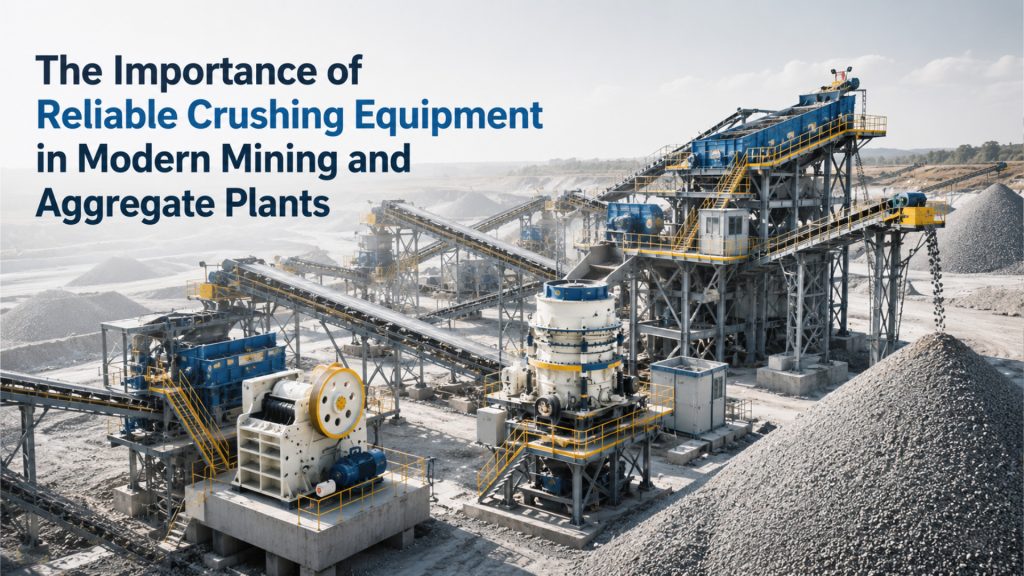
Mining and aggregate processing operations depend on a continuous flow of material through multiple stages of handling and processing. Among these stages, crushing is one of the most important because it determines how effectively raw material can be prepared for subsequent operations.
From large quarry stones to mineral-bearing rock, the material entering a processing plant often requires significant size reduction before it can be screened, washed, conveyed, separated, or further processed.
Reliable crushing equipment therefore forms the foundation of an efficient processing operation.
Why Crushing Is So Important
Raw material extracted from mines and quarries is rarely suitable for direct use. Large rocks and irregular material must first be reduced to controlled sizes.
Crushing provides several essential functions:
- Reduces large feed material
- Creates manageable particle sizes
- Prepares material for screening
- Improves downstream processing
- Helps achieve specified product sizes
- Supports continuous material flow
The effectiveness of this stage has a direct impact on everything that follows.
If the crushing process is inconsistent, downstream equipment may receive material that is too large, too fine, or poorly distributed. This can reduce overall plant efficiency.
Crushing in Mining Applications
Mining operations often deal with large volumes of hard and abrasive materials. Equipment must therefore be designed to withstand demanding working conditions.
A typical mining process may involve primary crushing followed by secondary and tertiary reduction before the material reaches the desired size.
Depending on the application, crushers may process materials such as:
- Iron ore
- Limestone
- Granite
- Basalt
- Coal
- Aggregates
- Construction materials
- Various mineral-bearing rocks
Each material has different physical properties, meaning crushing equipment must be selected according to the specific application.
Crushing in Aggregate Production
Aggregate plants require consistent particle sizes for applications such as roads, concrete, asphalt, railway construction, and infrastructure projects.
Product shape and grading can be just as important as production capacity.
A well-designed crushing circuit can help produce controlled aggregate sizes while reducing unnecessary fines and maintaining efficient material flow.
Consistent crushing also helps screening equipment operate more effectively, making the complete plant more productive.
The Role of Robust Machine Construction
Industrial crushing equipment operates under high mechanical loads. Heavy feed material, repeated impact, vibration, and abrasive conditions can place significant stress on machine components.
For this reason, robust construction is essential.
Important design considerations include:
- Strong structural frames
- Heavy-duty components
- Wear-resistant surfaces
- Proper bearing arrangements
- Reliable drive systems
- Accessible maintenance areas
- Appropriate safety provisions
A machine designed for demanding industrial conditions can provide better reliability and longer service life when properly operated and maintained.
Wear and Maintenance
Wear is a normal part of crushing operations. Crushing hard and abrasive material naturally causes wear on components that come into direct contact with the feed.
Ignoring wear can eventually affect:
- Product size
- Machine performance
- Energy consumption
- Mechanical reliability
- Production capacity
Regular inspection helps identify developing problems before they become major failures.
Preventive maintenance can include checking wear components, lubrication systems, bearings, drive components, fasteners, and other critical areas.
A structured maintenance program can significantly reduce unexpected downtime.
Reducing Unplanned Downtime
In a high-capacity processing plant, downtime can quickly become expensive. When a major crusher stops, upstream and downstream equipment may also be affected.
This is why reliability should be considered alongside production capacity.
A dependable crushing system should be designed for:
- Stable operation
- Easy inspection
- Efficient maintenance
- Availability of replacement parts
- Safe access to service areas
- Appropriate technical support
These factors contribute to higher equipment availability and more predictable production.
Efficient Material Flow
A crushing machine does not operate independently. Feeders, conveyors, screens, bins, and other equipment all influence crusher performance.
For example, inconsistent feeding can cause fluctuations in crusher loading. Poor screening can send incorrectly sized material back into the crushing circuit. Conveyor limitations can create bottlenecks even when the crusher has sufficient capacity.
Therefore, efficient plant design requires proper coordination between every major component.
Importance of Proper Feeding
The feeding system plays an important role in crusher performance.
A consistent feed helps maintain stable machine loading and improves production efficiency. Uneven or poorly distributed feed can reduce performance and create unnecessary stress.
Feeders may also help control the rate at which material enters the crushing chamber, allowing the crusher to operate more consistently.
For large-scale plants, proper feeding is particularly important because even small inefficiencies can accumulate over long operating periods.
Safety and Accessibility
Industrial crushing plants contain powerful mechanical equipment, moving components, conveyors, elevated platforms, and heavy materials. Safety must therefore be an important part of equipment design and plant operation.
Machines should be designed with appropriate guarding, access arrangements, inspection points, and maintenance provisions.
Clear access for inspection and servicing can also reduce maintenance time and help technicians work more efficiently.
Safe equipment is not only important for personnel—it can also contribute to more reliable plant operation.
Customization for Specific Applications
Not every crushing plant has the same requirements.
Some projects require compact equipment for limited installation areas. Others require high-capacity systems capable of continuous operation in large mining environments.
Customization may involve machine dimensions, capacity, drive arrangements, wear materials, discharge configurations, feeding systems, or integration with existing plant equipment.
A manufacturer with strong engineering capabilities can develop equipment around the actual operating conditions instead of relying only on a standard configuration.
Long-Term Value of Quality Equipment
The initial purchase price of crushing equipment is only one part of its overall cost.
Long-term value depends on:
- Machine availability
- Maintenance requirements
- Wear-part consumption
- Energy efficiency
- Production consistency
- Service support
- Equipment life
A machine that costs less initially but requires frequent repairs and replacement parts may ultimately cost more than a well-engineered machine with dependable long-term performance.
This makes quality an important investment decision rather than simply a purchasing consideration.
Working With an Experienced Manufacturer
Choosing a crushing equipment manufacturer should involve more than comparing specifications.
An experienced manufacturer can help customers evaluate their feed material, production requirements, crushing stages, plant layout, and maintenance expectations.
Engineering support can also help ensure that the crusher integrates correctly with existing equipment.
From initial selection and design through installation, commissioning, maintenance, and spare-parts support, a strong equipment partner can contribute to the overall success of a project.
Conclusion
Reliable crushing equipment is essential for modern mining, quarrying, aggregate production, and mineral-processing operations.
A properly designed crushing system can improve material handling, support consistent product quality, reduce downtime, and increase the efficiency of downstream processes.
The most successful plants are not built around a single machine. They are built around a complete process in which crushers, feeders, screens, conveyors, and supporting systems work together efficiently.
With robust engineering, appropriate equipment selection, preventive maintenance, and reliable technical support, crushing plants can achieve dependable performance even under demanding industrial conditions.
Investing in reliable crushing technology today helps build a more productive, efficient, and dependable processing operation for the long term.