
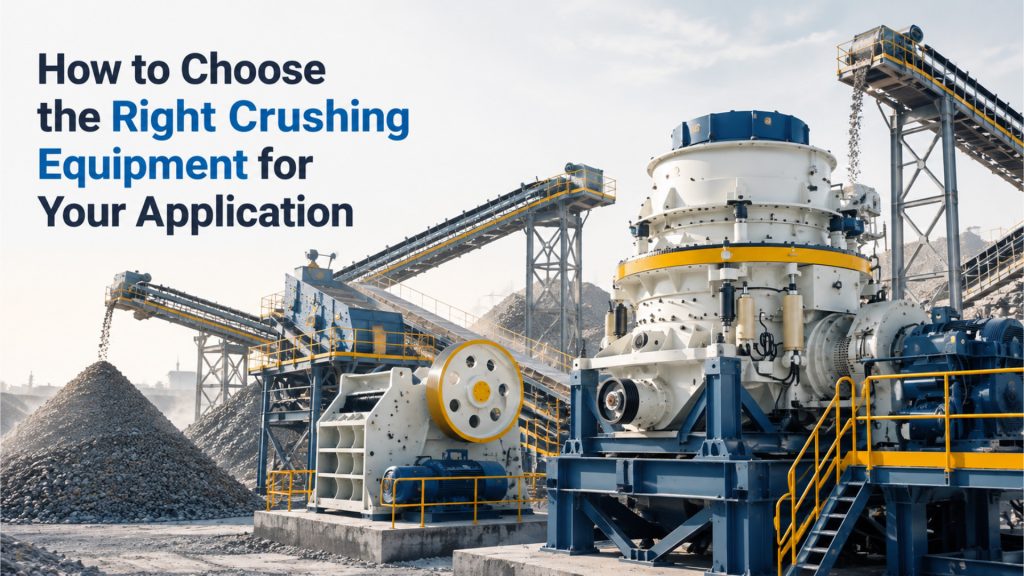
In industries such as mining, quarrying, construction, aggregates, cement, and mineral processing, crushing equipment plays a critical role in converting large, difficult-to-handle materials into manageable sizes. The efficiency of the crushing stage directly affects the productivity, operating cost, product quality, and overall performance of a processing plant.
However, selecting the right crusher is not simply a matter of choosing the largest or most powerful machine. Different materials, applications, capacities, and final product requirements demand different crushing technologies. Understanding the key factors involved can help businesses select equipment that delivers reliable performance and long-term value.
Understanding the Crushing Requirement
The first step in selecting crushing equipment is understanding exactly what the machine needs to accomplish. Every crushing application has different requirements based on the material being processed and the desired output.
Important considerations include:
- Type of material
- Material hardness
- Feed size
- Required output size
- Required production capacity
- Moisture content
- Abrasiveness
- Operating conditions
- Available installation space
- Maintenance requirements
For example, a machine designed for primary crushing may not be suitable for producing a finely controlled final product. Similarly, equipment suitable for soft limestone may not provide the same performance when processing highly abrasive rock.
A proper assessment of the application ensures that the selected crusher can handle the material efficiently without unnecessary energy consumption or excessive wear.
Primary, Secondary, and Tertiary Crushing
Crushing plants are commonly divided into primary, secondary, and tertiary stages.
Primary Crushing
Primary crushers receive the largest feed material directly from a quarry, mine, or excavation site. Their primary objective is to reduce large rocks into a size that can be handled by subsequent processing equipment.
Primary crushing applications often require machines with robust construction and high resistance to impact and heavy loads.
Secondary Crushing
After primary reduction, secondary crushers further reduce the material into smaller sizes. This stage helps achieve better control over the particle size distribution and prepares the material for further processing.
Secondary crushing is particularly important when a plant needs consistent feed for screening, washing, grinding, or other downstream processes.
Tertiary Crushing
Tertiary crushing is generally used when a finer product is required. This stage can help produce aggregates or mineral products with specific size and shape characteristics.
The number of crushing stages depends on the material, feed size, desired product, and overall process design.
Common Types of Crushing Equipment
Different crusher designs are developed for different applications. Understanding their general characteristics makes equipment selection easier.
Jaw Crushers
Jaw crushers are widely used for primary crushing applications. They operate by compressing material between a fixed jaw and a moving jaw.
They are commonly selected for their simple operating principle, robust construction, and ability to handle large feed sizes.
Cone Crushers
Cone crushers are commonly used for secondary and tertiary crushing. They work by compressing material between a rotating cone and a stationary crushing surface.
Cone crushers can be particularly effective when consistent product size and high reduction ratios are required.
Impact Crushers
Impact crushers reduce material through impact forces. They can be used in a variety of applications where particle shape and reduction are important considerations.
Their application depends heavily on material characteristics and the required product specification.
Hammer and Specialized Crushers
Hammer mills and specialized crushing machines are used for specific materials and process requirements. Depending on the design, these machines can provide high reduction ratios and efficient processing for suitable feed materials.
Choosing between these technologies requires a detailed understanding of the complete process rather than focusing on the crusher alone.
Capacity Matters
Production capacity is another major consideration. A crusher should be selected according to the required throughput rather than simply its maximum theoretical capacity.
If equipment is consistently operated beyond its intended capacity, several problems can occur, including:
- Increased wear
- Higher energy consumption
- Reduced product consistency
- More frequent maintenance
- Unplanned downtime
On the other hand, selecting equipment that is significantly oversized for the application can unnecessarily increase capital and operating costs.
The ideal solution is equipment appropriately matched to the expected operating conditions and production requirements.
Consider the Feed Material
Material characteristics have a major impact on crusher selection.
Hard and abrasive materials can cause significant wear on components. Softer materials may require a different crushing approach. Materials containing high moisture or sticky particles can also create challenges in feeding and crushing.
Important material properties include compressive strength, abrasiveness, moisture, density, and particle size distribution.
Understanding these characteristics before selecting equipment helps ensure reliable operation and longer component life.
Maintenance and Spare Parts
A crusher is only productive when it is available for operation. Therefore, maintenance should be considered at the time of equipment selection.
Equipment should provide practical access to components that require inspection, adjustment, lubrication, or replacement.
Availability of wear parts and spare components is equally important. A machine may have excellent technical specifications, but if critical replacement parts are difficult to obtain, downtime can become expensive.
A reliable equipment supplier should therefore provide appropriate technical support, replacement components, and maintenance guidance.
Energy Efficiency and Operating Cost
Energy consumption is an increasingly important consideration for processing plants. Efficient crushing can help reduce operating costs while maintaining required production levels.
Energy efficiency depends on several factors, including:
- Crusher design
- Material characteristics
- Feed distribution
- Reduction ratio
- Machine condition
- Operating parameters
- Overall plant configuration
A properly designed crushing circuit can often deliver better results than simply increasing crusher power.
Complete Plant Thinking
One of the most important principles when selecting crushing equipment is to look beyond an individual machine.
A crusher operates as part of a larger system that may include feeders, conveyors, screens, dust-control systems, washing equipment, storage systems, and other processing equipment.
Poor coordination between these components can create bottlenecks even when the crusher itself has sufficient capacity.
For this reason, equipment selection should consider the entire material-handling and processing flow.
Choosing a Reliable Equipment Partner
The right equipment supplier can make a significant difference in long-term plant performance. Beyond supplying machinery, an experienced manufacturer or engineering partner should understand the application and help develop a practical solution.
Customers should consider factors such as engineering capability, manufacturing quality, customization options, technical support, spare parts availability, and after-sales service.
The objective should not simply be to purchase a machine. It should be to establish a reliable crushing solution that performs consistently throughout its operating life.
Conclusion
Selecting the right crushing equipment requires careful consideration of material characteristics, capacity, feed size, output requirements, crushing stages, maintenance, energy consumption, and overall plant design.
Jaw crushers, cone crushers, impact crushers, hammer mills, and specialized crushing systems each have their own applications and advantages. The best solution depends on the specific requirements of the project.
By evaluating the complete process and working with an experienced equipment partner, businesses can improve productivity, reduce unnecessary downtime, control operating costs, and achieve consistent product quality.
The right crusher is not simply the machine with the highest capacity—it is the machine correctly matched to the application.